Music and Connection
Conducting with Compassion
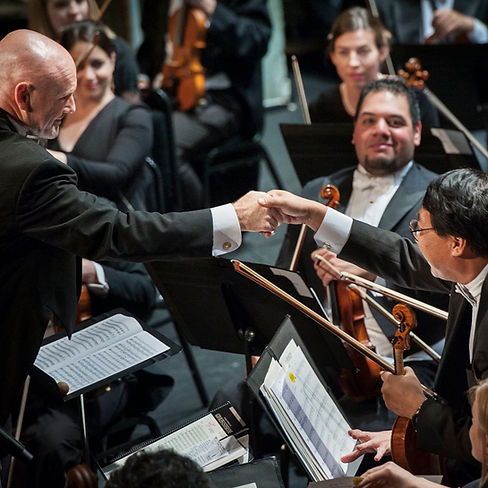
Leading with Compassion
Having empirically proven that music acts as a powerful clinical intervention for patient healing, Shannon's next crucial frontier was to turn these exact physiological mechanisms inward to address the hyper-critical, relentlessly stressful environment of the professional musician.
By shifting the focus from patient bedside to the rehearsal room and concert hall, Shannon realized that the same science of compassion and deep human connection could, and should be used to understand the unique pressures of the orchestral musicians world, in a way that can anchor trust, protect from burnout, and build systemic self-care.
From Neuroscience to Compassionate Leadership
Driven to anchor this work in hard science, Shannon immersed himself in evolutionary neuroscience and mind-body medicine. This led to deep collaborations with the world's leading minds in compassion science: Professor Paul Gilbert, OBE, PhD, founder of Compassion-Focused Therapy (CFT), and Professor Stephen Porges, PhD, pioneer of Polyvagal Theory. Through them, he mapped exactly how the human nervous system shuts down under threat and opens up under conditions of true safety.
In 2024, this specialized expertise brought him to Stanford University, where Professor James Doty invited him to serve as a Visiting Instructor at the Center for Compassion and Altruism Research and Education (CCARE). Surrounded by cutting-edge research on burnout and "compassionate leadership" in workspaces, Shannon had the realization that this data had deep parallels to the hyper-critical, ever-demanding world of the professional musician.


Creating the Conditions for Sustainable Excellence
Orchestras are crucibles for incredible music, teamwork and collaboration, but they are also hyper-critical, elite environments. Professional musicians perform under relentless, systemic scrutiny from music directors, colleagues, audiences, and importantly: their own punishing self-criticism. In this arena, precision and absolute accountability are non-negotiable. Musicians inherently love this rigor and embrace the high-performance challenge—but human resilience is not a fixed state. Shannon knows that even the most elite performers face moments where the psychological cost becomes unsustainable, yet conventional leadership models offer no way to notice when a musician is quietly struggling or when something is fundamentally "off."
The breaking point came during the COVID-19 pandemic. Peter witnessed firsthand the severe mental health crises professional musicians suffered when stripped of their ability to perform. Armed with his background, it was clear this wasn't just a loss of work; it was a profound threat to their systemic safety. Yet, when the industry returned to normalcy and players went back under contract, these deep-seated environmental pressures remained completely unaddressed. Shannon recognized that the solution wasn't to lower the standards, but to completely rewrite the environment—giving conductors the tools to read the room, recognize distress, and create a space where elite artists can safely sustain their excellence.
Compassionate Leadership on the Podium
The Conductor is in a truly unique position to create a space where elite professional musicians can thrive and safely sustain their excellence.